The meaning & origin of Saelira
Old English sǣ, “the sea.” Latin lira, “a furrow.” Together: the long bright line a ship draws across open water — carried, in ordinary use, as pearl of the sea.
What does Saelira mean?
Saelira means “pearl of the sea.” It is a modern European girl's name (said say-LEER-uh) formed from two elements that have been in continuous use in European naming for well over a thousand years: the Germanic word for the sea, and the Latin word for a furrow or ridge. Read literally, the Saelira name meaning is “furrow of the sea” — a wave crest or a ship's wake — and it is carried, in everyday use, with the warmer sense “pearl of the sea.”
the sea · Old Norse sær
a furrow; a raised ridge
Three readings, one name
Borne meaning: pearl of the sea.
Literal meaning: furrow of the sea — a wave crest, a wake.
Secondary reading: song of the sea, if the ending is taken
from Latin lyra.
The first element: sǣ — the sea
The opening syllable is the Old English noun sǣ, meaning “sea, ocean, large body of water.” Its Old Norse cousin is sær. Both descend from the same Proto-Germanic root that produced modern English sea, German See, Dutch zee, Danish and Norwegian sjø, and Swedish sjö. It is one of the most thoroughly European words there is.
Crucially, this element was already a name-building block in Anglo-Saxon England. It appears at the front of a number of recorded personal names:
| Name | Elements | Meaning |
|---|---|---|
| Sæwine | sǣ + wine | sea-friend |
| Sæberht | sǣ + beorht | sea-bright |
| Sæweard | sǣ + weard | sea-guardian |
| Sæwulf | sǣ + wulf | sea-wolf |
| Sæthryth | sǣ + þryþ | sea-strength |
Sæberht was a king of the East Saxons in the early seventh century; Sæwulf was a twelfth-century pilgrim whose account of a voyage to Jerusalem still survives. The element is not decorative — it is documented, and it was used exactly the way Saelira uses it: as the first half of a compound.
The second element: lira — the furrow
Latin lira means “a furrow,” and more precisely the raised ridge of earth thrown up between two furrows by a plough. It is the root of the English word delirious — literally de-lira, “off the furrow,” one who has strayed from the straight line. The image built into the word is a long, drawn, deliberate line across a surface.
Applied to water, that image needs no explanation. A hull ploughs. A wake is a furrow. The crest of a wave is a ridge. The compound is doing something the language already does on its own.
Why “furrow of the sea” is a compliment
Read literally, Saelira gives “furrow of the sea.” To a modern ear that sounds oddly agricultural until you notice that it is precisely the move Old English and Old Norse poets made constantly. Their sea-kennings — compressed two-word metaphors — did nothing else:
- hronrād — “whale-road,” the sea
- swanrād — “swan's path,” the sea
- seġlrād — “sail-road,” the sea
- ȳþa ful — “cup of the waves”
- brimhengest — “surf-stallion,” a ship
A road across the water; a horse that runs on it. Against that background, “furrow of the sea” is entirely idiomatic: it names the wake, the crest, the line of white a boat leaves behind. Saelira is a kenning that happens to scan like a girl's name.
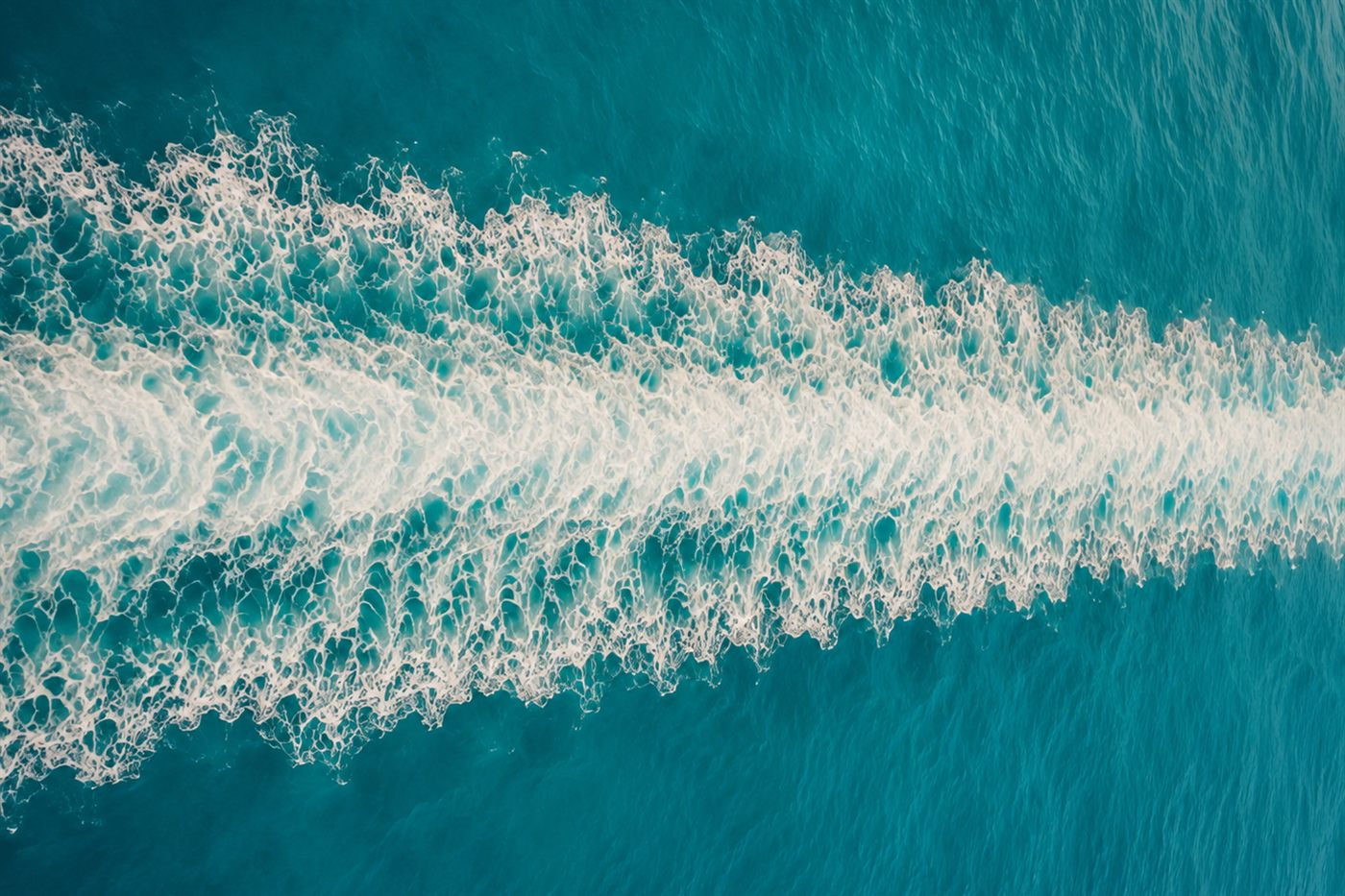
Ofer hronrāde hyran scolde — “over the whale-road he had to obey.”
Beowulf, line 10
The borne meaning: pearl of the sea
Names are carried with the meaning their bearers give them, and Saelira is borne as “pearl of the sea.” This is not a mistranslation but the ordinary life-cycle of a name: the literal sense supplies the image, and use settles on the one that fits a person.
The pearl reading holds together because a pearl is the sea's one precious product — the only gem that grows inside something living, in salt water, without a mine or a cut. For a name that means a rare thing brought up out of the ocean, it is hard to improve on.
A gap between a name's literal roots and the meaning it is carried with is completely ordinary. Melissa is Greek for “bee” but is universally carried as “sweetness, honey.” Miranda is Latin for “to be wondered at,” invented by Shakespeare and now simply “admirable.” Wendy came from a child's mispronunciation in a J. M. Barrie manuscript. A name's working meaning is the one its bearers give it — and here that meaning is “pearl of the sea,” the jewel the ocean makes. Margaret, from Greek margarites, has meant “pearl” outright for two thousand years; Saelira reaches the same image not by derivation but by choice, which is the more honest way to describe it.
The secondary reading: song of the sea
There is a second, equally defensible derivation. If the final element is taken not from lira but from Latin lyra — itself from Greek λύρα (lyra), the seven-stringed lyre of Orpheus and Apollo — then Saelira reads as “song of the sea” or “lyre of the sea.”
The two Latin words differ by a single vowel, and in later Latin the y of lyra was pronounced identically to i, so the overlap is not a stretch. It also connects the name directly to Lyra, the northern constellation, and to the modern name Lyra that has climbed steadily since the 2000s.
Either way, the sea holds
Furrow, pearl or song — the first element never moves. Whatever reading a family prefers, Saelira is a sea name, and that is the part a child will actually be told.
Is Saelira a European name?
Its roots are entirely European, and they span the continent's two great naming traditions. The first element is Germanic: Old English and Old Norse, the languages of the North Sea and the Baltic, which gave Europe names like Emma, Matilda, Astrid, William and Edith. The second is Latin: the parent of Italian, Spanish, French, Portuguese and Romanian, and the source of Clara, Laura, Julia, Beatrice and Stella.
Names that join the two are the European norm, not the exception. Saelira sits in the same tradition as the Norman-French and Anglo-Latin hybrids that followed 1066 — northern consonants softened by southern endings.
Practically, this means the name is readable across the continent. The -a ending is standard feminine in Italian, Spanish, Portuguese, Polish, Czech, Swedish and German. The lira element is a live word in Italian. Nothing in the spelling requires a letter outside the basic Latin alphabet.
Is Saelira a modern coinage?
Yes, and it should be said plainly: Saelira is a modern name built from historical elements, not a medieval name that survived. There is no recorded Saelira in the Domesday Book.
That is a description, not a defect. The list of coined names now indistinguishable from ancient ones is long:
| Name | Coined by | When |
|---|---|---|
| Miranda | Shakespeare, The Tempest | 1611 |
| Jessica | Shakespeare, The Merchant of Venice | c. 1596 |
| Pamela | Philip Sidney, Arcadia | 1590 |
| Vanessa | Jonathan Swift | 1726 |
| Lorna | R. D. Blackmore, Lorna Doone | 1869 |
| Wendy | J. M. Barrie, Peter Pan | 1904 |
Each was new once, and each was built the way Saelira is built — from materials already lying in the language. What distinguishes a name that lasts from one that dates is not age but construction: whether its sounds are ordinary and its shape is familiar. Saelira's are.
How the name is built, sound by sound
Three syllables, stress on the second, ending in the open -a that marks feminine names in most European languages. The rhythm is the same as Elira, Amira, Samira, Delira and Almira — a pattern English speakers parse instantly.
- Sae- — from sǣ, pronounced “say”
- -lir- — the stressed heart, “LEER” (as in clear)
- -a — the feminine ending, “uh”
The full pronunciation guide →
Related names by meaning
Other girls' names that carry the sea, the pearl or the song:
- Marina
- Maren
- Marisol
- Cordelia
- Margaret
- Perla
- Margarita
- Meredith
- Muriel
- Nerissa
- Thalassa
- Lyra
- Delmare
- Oceane
- Morwenna
- Ondine
How Saelira compares to each →
Sources & further reading
The Old English element sǣ and the names built on it are documented in the standard Anglo-Saxon onomastic literature, including W. G. Searle's Onomasticon Anglo-Saxonicum (1897) and the Prosopography of Anglo-Saxon England. Latin lira and lyra are entries in Lewis & Short, A Latin Dictionary. Old English sea-kennings are drawn from Beowulf and The Seafarer. Saelira itself is a modern formation; this page documents the elements, not a historical attestation of the compound.